The Color of War: How One Battle Broke Japan and Another Changed America by James Campbell
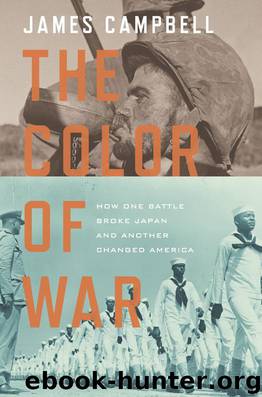
Author:James Campbell
Language: eng
Format: mobi
Tags: Military, World War II, History
ISBN: 0307461211
Publisher: Crown
Published: 2012-05-15T00:00:00+00:00
CHAPTER 31
Red Flags
Lieutenant Paul Zacher from the Port Director’s office had inspected the E. A. Bryan and given the Liberty ship the green light to be rigged and loaded. Although her winch bearings had been greased and her piston rods and valve stems oiled, just hours later problems surfaced. The driver on the No. 1 winch was lowering a net of bombs when he realized the brake was stuck in the off position. A greenhorn operator would have panicked and sent the bombs free-falling. Fortunately he had been running the winches long enough not to have to depend on the brake. If he kept his cool and the steam pressure lasted, he could bring the load down without smashing it on the deck of the ship or dropping it on top of the men working in the hold.
After bringing the load down safely, the winch operator alerted the ship’s third mate, who was charged with keeping the ship, its crew, and its cargo safe, about the problem. He, in turn, relayed the message to the Bryan’s chief mate and engineer, who evidently never followed up. Some of the division heads may also have been notified. If they were, they decided that the problem was not an urgent one. As long as the winch was semifunctional, there was no point in losing valuable loading hours by shutting it down.
On the Bryan’s No. 4 winch, Lieutenant Richard Terstenson, one of Lieutenant Commander Alexander Holman’s two assistant loading officers, discovered that a valve (the petcock) was loose on the compression regulator. So much hot steam was escaping that the winch driver found it difficult to do his job. The steam burned his skin and created such a fog that he could not see his signalman on the deck of the ship. Terstenson immediately alerted the ship’s engineer, the same man who earlier had chosen not to attend to the defective brake on the No. 1 winch.
Still, the loading did not stop. For two solid months in the lead-up to the invasion of Saipan and the Marianas, the pressure at Port Chicago had been intense. The autocratic Captain Merrill Kinne, the depot’s head officer, constantly reminded his division heads of daily tonnage goals, and they in turn reminded the seamen. The port director’s office warned Kinne, as it had warned his boss, Captain Goss, that loading ten tons of high explosives per hour was beyond Port Chicago’s capacity. But Kinne, like Goss, wanted nothing to do with anyone looking over his shoulder, and banished the Coast Guard from the pier. “Explosives,” he said, “will be quite safe so long as one realizes that they are dangerous.” The expectation was that the Bryan would be topped off and sent downstream as quickly as possible.
Later that day Lieutenant Terstenson told Lieutenant Commander Holman that he did not approve of the way the seamen rolled and skidded Mk-47 Torpex-loaded aerial depth bombs from the second tier of the boxcar down a wooden chute to the dock. Terstenson
Download
This site does not store any files on its server. We only index and link to content provided by other sites. Please contact the content providers to delete copyright contents if any and email us, we'll remove relevant links or contents immediately.
| Anthropology | Archaeology |
| Philosophy | Politics & Government |
| Social Sciences | Sociology |
| Women's Studies |
Cecilia; Or, Memoirs of an Heiress — Volume 1 by Fanny Burney(32561)
The Great Music City by Andrea Baker(32021)
Cecilia; Or, Memoirs of an Heiress — Volume 2 by Fanny Burney(31958)
Cecilia; Or, Memoirs of an Heiress — Volume 3 by Fanny Burney(31944)
We're Going to Need More Wine by Gabrielle Union(19051)
All the Missing Girls by Megan Miranda(16043)
Pimp by Iceberg Slim(14519)
For the Love of Europe by Rick Steves(14155)
Bombshells: Glamour Girls of a Lifetime by Sullivan Steve(14079)
Talking to Strangers by Malcolm Gladwell(13375)
Norse Mythology by Gaiman Neil(13374)
Fifty Shades Freed by E L James(13245)
Mindhunter: Inside the FBI's Elite Serial Crime Unit by John E. Douglas & Mark Olshaker(9346)
Crazy Rich Asians by Kevin Kwan(9295)
The Lost Art of Listening by Michael P. Nichols(7507)
Enlightenment Now: The Case for Reason, Science, Humanism, and Progress by Steven Pinker(7315)
The Four Agreements by Don Miguel Ruiz(6767)
Bad Blood by John Carreyrou(6625)
Weapons of Math Destruction by Cathy O'Neil(6283)
